
This post is all about the simple daily writing habits you can implement to become a more productive writer so you can advance your book while enjoying your writing journey.
What if I told you that all it took to become a more productive writer was implementing a few small writing habits into your daily writing routine?
In this post, I’m sharing with you 9 simple daily writing habits that help you achieve writing flow faster while also enjoying the writing process. No more pressure. No more stress. No more burnout. You can integrate these small, playful writing habits into your everyday life to make writing feel lighter, easier, and more fun… even on busy days.
If you prefer the video version, check out the YouTube video below to discover what small daily writing habits we can use to write more consistently, get into flow faster, and make the writing sessions more enjoyable.
Writing Habit #1: Start with a tiny writing warm-up
Sometimes, when you start your writing session, it can take a little while to get into writing mode. One simple action you can take to help you get there much faster is reading what you wrote the previous day.
This small first step helps you warm up for the new writing session. As you read, you remember what you wrote, what your characters are doing right now, and what was the last thing that happened in the story.
By reconnecting with your story first, it becomes much easier, and more fun, to continue writing right where you left off.
Writing Habit #2: Create a daily writing trigger
Is there anything you could use to signal to your brain that it’s time to start writing? Maybe you train your brain to know that your writing starts right after breakfast? Or after an early morning walk. Or, if you’re a night owl, right after dinner.
By adding your writing session into a specific time slot in your daily routine, it becomes much easier to start writing because you’re signaling to your brain that this is writing time now.
Your brain learns the pattern: you’ve done your daily exercise, and the next thing it expects is for you to sit down and write. So you’re basically training your muse to show up as soon as you take that action.
Writing inspiration… on command.
Writing Habit #3: End every session mid-sentence
I’ve heard several authors suggest this habit, but it’s not one that works for me personally. I’ll still mention it here because many writers do find it useful.
The idea is to stop your writing session mid-sentence, so that the next day it’s easier to jump straight back into writing by continuing from where you left off.
Every time I’ve tried to do this, it has actually made me more confused. When I’m writing, I know exactly what I want to say, but if I stop mid-sentence, the next day I don’t always remember how I wanted to phrase that sentence or where I was going with it.
Give it a try and let me know if it works for you. I’m curious if it actually helped you get into writing faster.
Writing Habit #4: Set a ridiculously easy daily writing goal
Sometimes we procrastinate on starting to write because our word count target is overwhelming. If you say to yourself, “Today, I have to write 3000 words,” that can feel overwhelming, and it makes you dread even starting your writing session.
But what if, instead of 3000 words, you set your word count target to just 100 words? Suddenly, that feels much more achievable and a lot less intimidating.
And here’s the fun part: once you start writing, you often end up writing a lot more than 100 words. Lowering the word count target for the day might actually help you write more, and you’ll feel a lot less stressed while writing.
Writing Habit #5: Turn writing into a mini game
Writing is always easier when you have fun writing. When you find ways to gamify writing, you turn a task into a playful, fun activity instead of a chore.
So what can you do to gamify writing? One simple way is to use the Pomodoro technique and, with each new writing sprint, try to beat your word count from the previous writing sprint. It becomes a friendly competition with yourself where the only winner is you. And no matter what your final word count is, you still win, because you’re advancing your book.
RELATED POST: The Pomodoro Technique for Writers
If you need help tracking your word count, I created a free word count tracker Google Sheet (linked in the form below) that you can use to track your writing sprints, your daily writing progress, and your overall book progress.
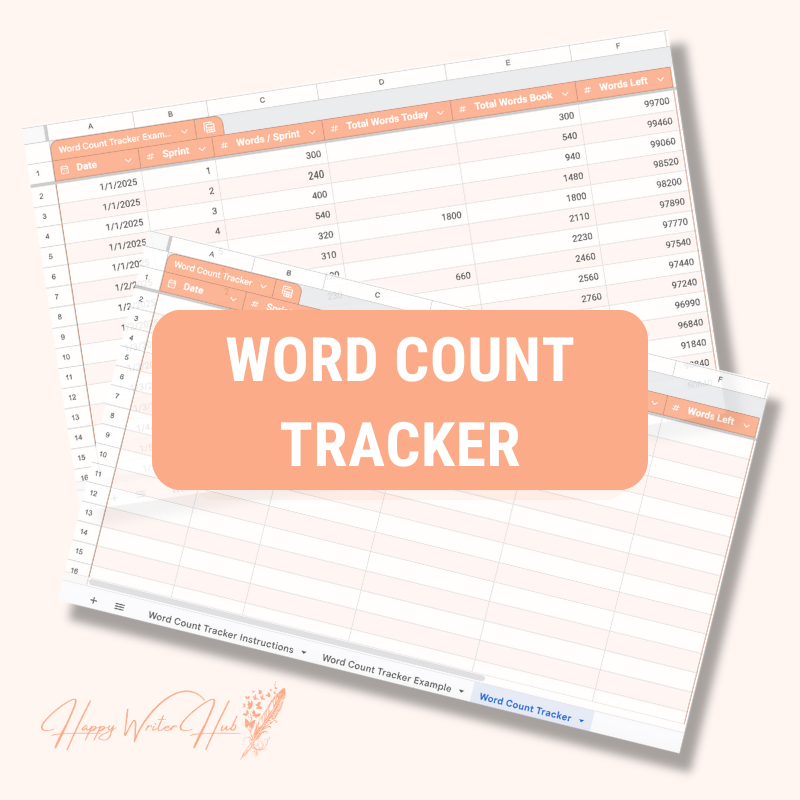
And if you love stickers, like I do, you can use them to decorate your writing tracker every time you reach a new writing milestone. Pretty stickers as a reward for playing a fun writing game.
There are so many fun ways to gamify writing and enjoy the writing sessions more. What’s your favorite way to gamify writing?
Writing Habit #6: Create a writing ritual you love
Having a writing ritual signals to your brain that you’re in writing mode, and that this is the time to focus only on your writing.
Your writing ritual doesn’t have to be complicated. It can be as simple as having one dedicated spot in your home where you always write. Or maybe you always write at your favorite café.
You can also create a fully immersive writing atmosphere for your session using lighting, sound, a specific place, a dedicated keyboard, or even a special coffee next to you. All of these little cues signal to your brain that this is writing time.
My writing ritual includes fairy lights and the Ravenclaw Common Room sound atmosphere from ambient-mixer.com. What’s your special writing ritual?
Writing Habit #7: Separate writing time from editing time
One thing that really helped me increase my daily writing productivity was separating writing from editing. Writing and editing use two different parts of the brain.
When you’re writing, you’re being creative. You’re building new worlds, creating new characters, and using your imagination to the fullest. When you’re editing, on the other hand, you’re being more analytical, checking for errors and fixing things that are already on the page.
So when you keep switching from writing to editing during the same session, everything slows down. Your brain keeps switching from creative mode to analytical mode, and that makes the entire process feel a lot harder than it needs to be.
A simple fix is to keep them separate in your daily writing routine. Write first and write messy. Nobody is going to see it or judge your first draft. And when it’s done, you can go into analytical mode and focus on refining and improving your manuscript.
Writing Habit #8: Celebrate showing up (not word count)
When we’re ambitious and overly critical of ourselves, we can start to feel guilty if we show up for the writing session and end up not writing any new words.
But just because you didn’t add any new words to the page doesn’t mean that you didn’t make progress on your book. Maybe your writing session was spent brainstorming new ideas on where to take the plot next, or coming up with new ways to make your characters miserable, or how to save them.
Maybe you simply reread what you wrote last time, so you can reconnect with your story and figure out how to continue tomorrow. All of that counts as progress.
Just because you don’t have a new number to add to your word count tracker doesn’t mean you weren’t working. Writing is so much more than adding one word after another. It involves lots of brainstorming, world-building, character development, and just… thinking.
Celebrate showing up and spending time in the world of your book, even if it was just for a short while.
Writing Habit #9: End the writing day on a cheerful note
We often tend to focus on the critical side. So we say to ourselves, “I only wrote this many words today,” or “I should be further along after this writing session.”
But remember that every small progress is still progress. And both your current writing session and your next one will feel so much better if you take a moment to celebrate today’s wins.
Celebrate that you showed up. Give yourself a little sticker, or a bigger reward, for another day where you showed up for your book. Leave yourself an encouraging note for tomorrow. Find small, fun ways to celebrate and end today’s session on a positive note.
When you do that, the day and your writing will feel lighter and happier. You’ll enjoy the process so much more when you celebrate your progress instead of criticizing yourself for not being where you thought you “should” be.
Big writing goals are built on small daily writing habits. Choose the ones that feel good, let go of the rest, and enjoy the process of becoming a more consistent writer.
This post was all about the simple daily writing habits that can help writers be more productive. If you enjoyed it, you might also enjoy this post:
Learning from the Writing Habits of Famous Authors
Now it’s your turn. Let me know in the comments which tiny writing habits you’ve implemented in your own writing routine that have significantly boosted your writing productivity.





Leave a Reply