
This post is all about writing without distractions to help you find the focus you need to make real progress on your book.
Distractions are stealing your stories. Every little thing that interrupts your writing session breaks your writing flow, drains your creativity, and makes writing feel so much harder than it needs to be.
Today, dear happy writer, I will share with you seven simple tips for writing without distractions. You can create your own distraction-free writing sessions by identifying the biggest distractions you personally face, setting clear digital and personal boundaries, and creating a clutter-free writing and mental space.
These small but powerful shifts will help you focus better, feel more inspired, and build a consistent, joyful writing momentum.
If you prefer the video version, check out the YouTube video below for tips on writing without distractions.
TIP #1: Identify common writing distractions
The first step in building a distraction-free writing session is to figure out exactly which distractions you’re dealing with. Some authors find it perfectly fine writing with a lot happening around them, while others need complete quiet and isolation to truly focus and be productive.
Which one are you? And most importantly, what are the things you need to remove from your surroundings so you can focus on your writing?
Is it the constant notifications from all the emails, social media updates, and the news? Is it that you’re constantly thinking of your long to-do list and all the house chores waiting for you? Or do you need to take a break from your dogs, cats, or even family members during your writing time?
Knowing which distractions you can handle and which need to go is a powerful first step toward creating the right environment for a focused, enjoyable, and productive writing session.
TIP #2: Design a distraction-free writing space
Let’s start with your desk. When we discussed the playful ways to overcome writer’s block, we saw the importance of a clutter-free space for your creativity.
RELATED POST: How to Overcome Writer’s Block Through Play
When you’re trying to write but your desk is full of things competing for your attention, it becomes so much harder to focus. Instead of trying to push through and not actually getting anything on the page, probably the best thing you could do is to first clear your writing space.
Remove all unnecessary items from your desk and keep it as clear as possible so your creativity has space to move around. Writing in a clutter-free space will enhance your focus, creativity, and writing speed.
That’s also why your words seem to flow so smoothly when you write in a café. When you’re there, you don’t have all those things crowding your writing space. All you have is your laptop, and maybe a notebook, and that’s it. It’s just you and your story.
RELATED POST: How Writing in a Café Helps Writers Be More Creative and Productive
So try to recreate that atmosphere at home—your own little writing corner where it’s just you and your book, with nothing else getting in the way.
TIPS #3&4: Set clear boundaries to write without distractions
Maybe your space is clutter-free, but distractions are still finding their way in through your laptop… or the people and pets around you. Let’s tackle these separately, because each one needs a slightly different approach.
(3) Digital boundaries
One of the biggest sources of distraction during your writing session comes from all the notifications constantly popping up on your screen. Everything that’s happening on social media, all your friends’ updates, all the funny cats and dogs and dancing parrots, the “urgent” emails that are not really urgent, and all the world news demanding your attention can wait until after your writings session.
So close all unnecessary tabs, turn off all notifications, and silence your phone as well. If you need to keep your phone on for emergencies, you can set it up so that only certain people can reach you during your writing session.
That’s exactly what I do. I have a setting where my mom is the only person who can contact me, and everyone else can wait until I’m done writing. Simple, clear, and so effective.
(4) Personal boundaries
Now let’s talk about the people and pets around you. Setting boundaries here looks a little different depending on your situation.
If you have babies, or even young kids, it’s less about setting strict boundaries and more about working around their schedules. Maybe you can have your writing session while your kids are sleeping, or when they’re at school. Maybe you can ask your partner or a family member to look after them while you take half an hour to focus on your book.
Your family members are understanding. They love you and they want your dreams to come true. So in most cases, they’ll be happy to support you and give you a chance to work on the things you love. You just have to ask for their support.
The same is true if you don’t have kids but share your space with other people. You can still create boundaries even if you live in a small apartment where you might not have a room that you can lock yourself in to work on your book. Let your housemates know you need a little time to yourself without interruptions. Just tell them that for half an hour you’re off-limits, put your headphones on and start typing.
TIPS #5&6: Writing without distractions by clearing mental clutter
Besides all the clutter and chaos that might be around you, if you want a truly focused writing session, you also need to remove the internal clutter. All those thoughts running around in your head are just as distracting as the outside chaos.
So how do we remove mental clutter? There are two powerful actions you can take to clear mental clutter before starting your writing session.
(5) Meditating
First, doing a short meditation before your writing session can help you calm your mind so you can start writing with a fresh, clear focus.
I’ve seen for myself just how effective even a short meditation can be. Meditating in the morning has a huge impact on my focus throughout the day.
When I sit down to write after meditating, I can think more clearly, I’m able to focus for longer, and my writing flows so much more easily. And because of that, I’m far more productive during my writing sessions.
So I highly, highly recommend meditating for having focused, productive writing sessions.
(6) Brain dump
Another big source of distraction when you write is all the thoughts that keep popping into your mind. These may be thoughts about the book you’re currently writing, or ideas for future books you’d like to write, or something completely unrelated.
Whatever those thoughts are, they take up space in your brain and can be very distracting.
So the best way to deal with these distractions is by doing a quick brain dumb before you start writing. Write down all your ideas for your current book and what you want to accomplish during this writing session. If you have ideas for other books, write them down on a separate list. And if you’re thinking of what needs to be done around the house, the groceries, and the friends you need to call, put those on a separate to-do list.
Then put the last two lists away, and keep the one with the tasks you need to achieve during the current writing session. And focus on that.
TIP #7: Writing without distractions by using time blocks
Writing in short, focused time blocks, like in the Pomodoro Technique, can dramatically increase your focus. It’s because you’re giving yourself a small, defined window of time where your only goal is to move your story forward.
You can motivate yourself by saying, “I only need to focus during this short time.” And then start writing.
You write continuously for 25 minutes, and then you take a break. You can, of course, adjust the timer to match your focus. If you can only focus for 15 minutes, that’s okay. Or maybe you’ve created such a distraction-free environment that you can write continuously for 60 minutes. Amazing! Go for it! Use the time interval that works best for you.
The important thing is that during that time you keep writing. Having a timer counting down dramatically increases your focus because your brain knows this is your dedicated writing time, and everything else can wait. So you strive to write as much as possible during that short time block.
RELATED POST: The Pomodoro Technique for Writers
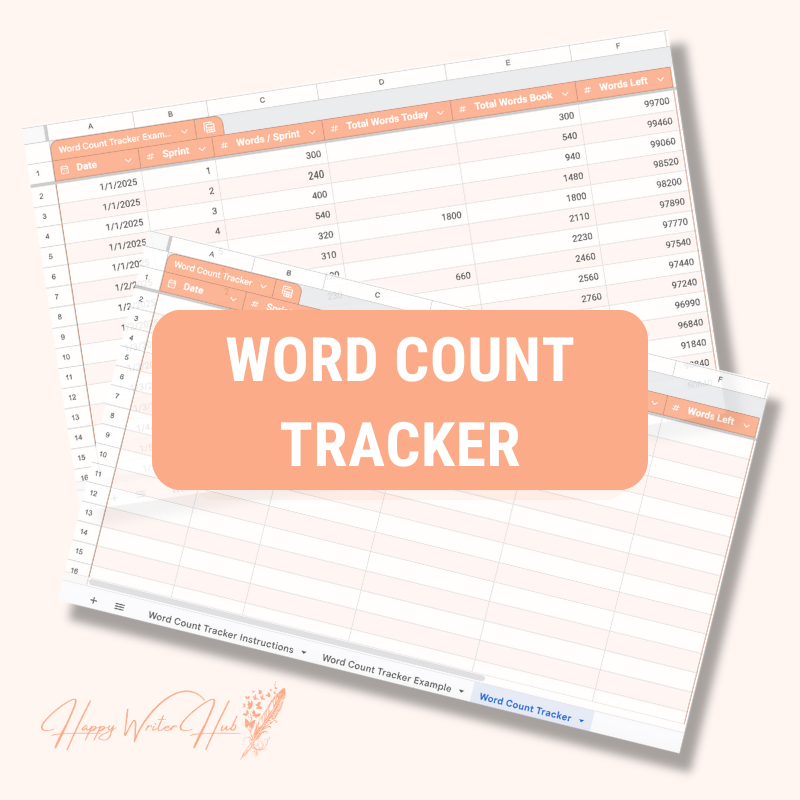
If you need help tracking your writing sprints, I created a Google Sheet where you can track the word count for each writing sprint of the day. It then automatically calculates your word count for the day, your total word count for the book, and how many words you still have left until you reach your target ford count for your book. You can download it for free using the form below.
But just as the writing blocks are important, the breaks between the writing sprints are just as important. Your brain needs to take a break between writing sprints so that you can clear your mind and organize your thoughts for the next session. So make sure to also give your brain the time to relax.
This post was all about writing without distractions so you can be fully focused on your manuscript during your writing sessions. If you enjoyed it, you might also enjoy this post:
Overcoming External Writing Obstacles: How to Stop Letting Life Sabotage Your Writing Goals
Now it’s your turn. Let me know in the comments what is the biggest distraction that keeps pulling you away from your writing. How do you usually deal with it?





Leave a Reply