
This post is all about how to gather the courage to write your first book so you can finally give your dream the chance it deserves.
You really want to write this book you’ve been thinking about nonstop. But every time you sit down or even think about starting, the doubts come flooding in. What if I can’t write? What if people judge me for writing a book? What if my book is terrible?
But don’t worry, dear Happy Writer. These fears are part of every writer’s journey, especially when you write your first book. And if you want to finally begin, you don’t need to make those fears disappear completely. You just need to learn how to quiet them enough so you can start writing anyway.
In this post, I’ll offer 5 tips on how to gather the courage to write your first book despite your fears and self-doubt so you can make your dream a reality. If you prefer the video version, check out the YouTube video below for tips on how to gather the courage to write your first book.
In this post, we’re focusing on the mindset tips that will help you gather the courage to write your first book. And in the next week, we’ll focus on more practical advice to make starting your first book easier, so the process doesn’t feel so overwhelming.
Tip #1: Stop waiting to feel completely ready to write your first book
You have this dream to write a book, and you would love to start, but just the thought of starting feels so scary that it almost feels paralyzing.
You keep asking yourself… What if I start and realize I don’t know how to write? Should I learn more about writing before I begin? Maybe I’ll feel more prepared once I watch a few more YouTube videos about writing. Or maybe I should buy a few more courses first.
All of these are valid questions. We all ask ourselves these questions, especially when we’re about to embark on a project dear to our heart. And yes, it is good to learn about writing and have an idea of what you want to write. That definitely helps when you start writing.
But the more you keep asking these questions instead of actually starting to write, the less likely you are to actually start writing. You’re probably never going to feel completely ready to start writing your book. So if you keep waiting to be ready to start writing your book, you might end up never starting at all.
So just start! Start writing!
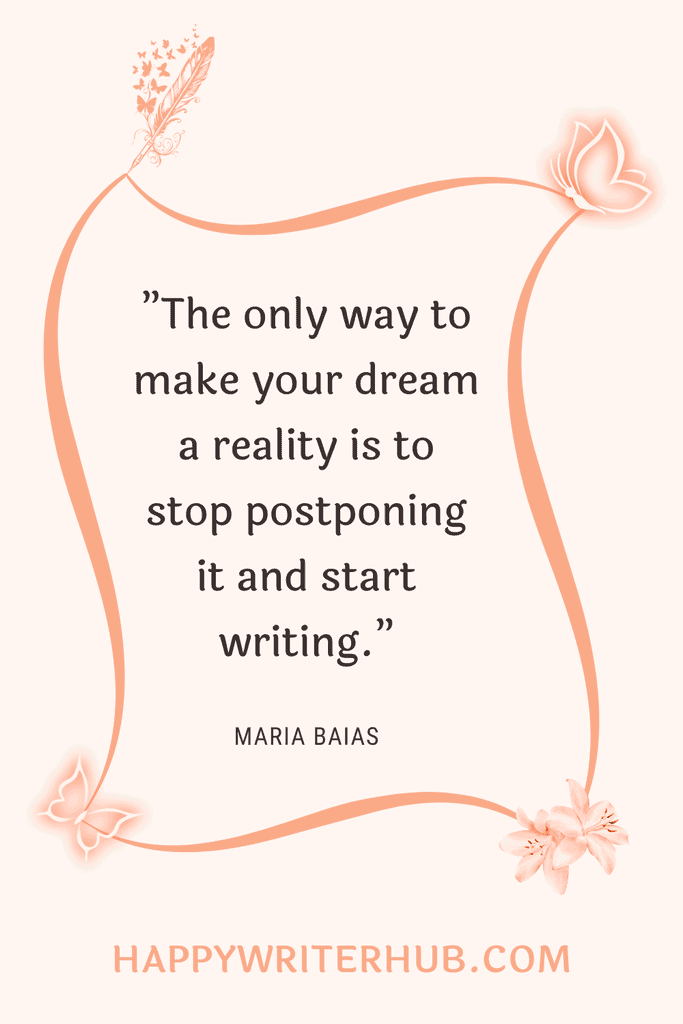
We hear this advice all the time: start before you’re ready. And it’s absolutely true. Yes, it’s scary, even terrifying, but the only way to make your dream a reality is to stop postponing it and start writing.
You can figure out the details along the way. You can learn more as you write. And the best way to learn something is by actually doing it.
So start writing now! I’m cheering for you! Start now, and whenever you need a bit of encouragement, come back here, and I’ll likely have another blog post ready to support you on your writing journey.
Tip #2: Let yourself be a beginner
A huge fear when you write your first book is that your book might not be good enough. And it probably won’t be…
Not exactly the encouragement you were expecting, is it? Just bear with me, it’s all for the greater good.
What I mean is that when you write your first book, it’s very possible that your first draft won’t be great. But that’s okay. Even experienced writers often don’t write amazing first drafts. That’s just how the writing process works.
The first draft is simply there to give you something to revise over and over again until you turn it into the publishable version of your book. All your favorite books have gone through several rounds of revisions before becoming the books you read and loved.
So don’t worry about writing the perfect first draft. You will make a lot of mistakes, but that’s all part of the process of writing a book. Never view those mistakes as failures. There’s no failure here, only lessons learned.
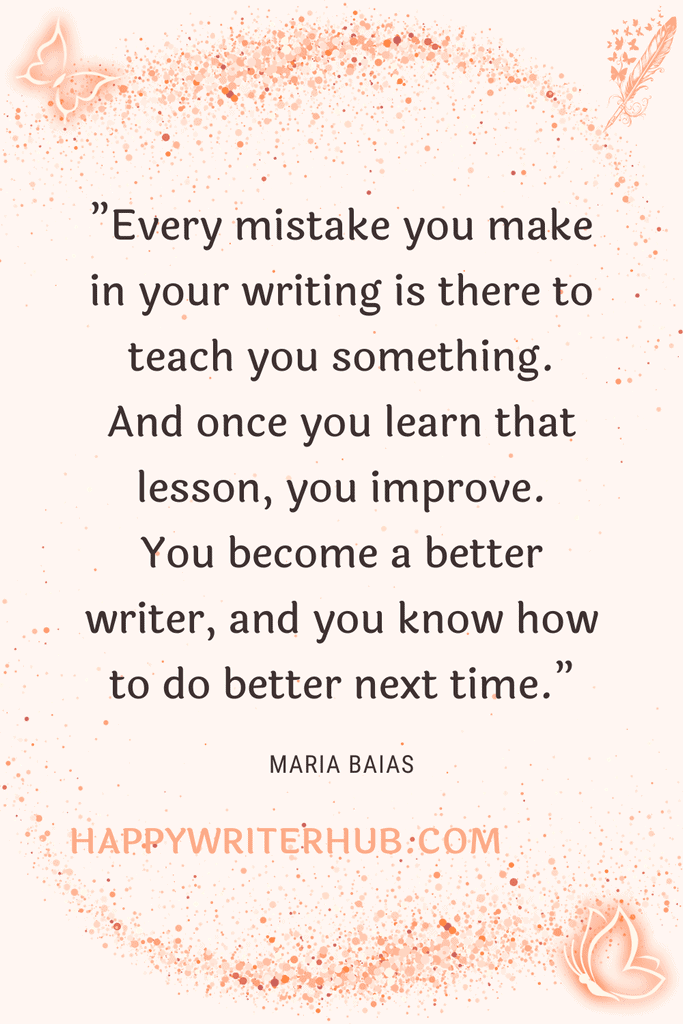
Every mistake you make in your writing is there to teach you something. And once you learn that lesson, you improve. You become a better writer, and you know how to do better next time.
It’s exactly like in real life. We make mistakes all the time. But if we keep dwelling on those mistakes and let them prevent us from moving forward, we’ll stay stuck. On the other hand, if we analyze what we did wrong and commit to improving, it will help us grow so we can do better next time.
So don’t worry about your mistakes. Just view them as your biggest teachers who are trying to show you how to improve your craft and become a better writer.
Tip #3: Focus on the story you want to tell, not what others might think
So often in our lives, we stop ourselves from doing something we’re excited about, something we would really love to do, because we’re afraid of what others might think of us.
And that fear stops us from taking action. It keeps us stuck in our own heads, where we keep repeating the same scenarios over and over again. What will people think of me when they see this whole new side of me they didn’t know I had?
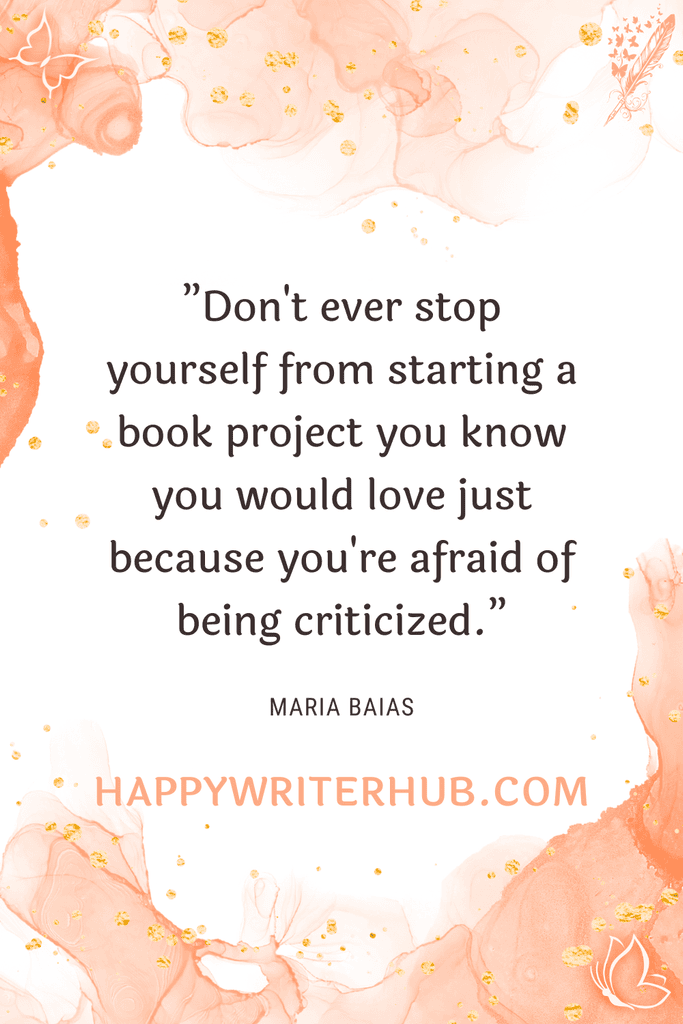
But as someone who’s done this in the past and has postponed doing or sharing my creative projects out of fear of criticism, here’s my advice to you: don’t ever stop yourself from starting a project you know you would love just because you’re afraid of being criticized.
Yes, some people might talk. Some might criticize. But it’s likely they’re not doing it because they want to be mean. They simply didn’t know this side of you, and they may be surprised to see a completely new side of you.
So don’t hide it. Don’t hide your creative, playful, quirky side. Be all that you are and infuse your creative project with all that you are.

And don’t worry so much about want others may say. Just focus on your book and what you want to share with the world through your writing. Focus on the joy of writing and creating something entirely new. That’s so much more fun that worrying about people’s opinions.
Even the writing itself flows more smoothly, and it’s so much more fun when you come to your project from a place of joy and excitement instead of a place of negativity and worry.
And if you’re really worried about other people’s opinions, remember this: you don’t have to share your dreams with anyone right now.
In fact, I was just learning in my Kabbalah lessons that it can actually be better not to share a new project with people during its inception phase, when the project is most vulnerable. During that time, your work can be more vulnerable to the doubt, judgment, and other people’s fears.
And I think that, as new writers, we already have plenty of internal doubts. We don’t need to be influenced by external ones as well.
So keep it to yourself until you feel more confident about it. Work on it, let it flourish, and once you feel ready, you can start sharing your work with excitement and confidence.
RELATED POST: How to Overcome Self-Doubt as a Writer
Tip #4: Gather evidence that you can do hard things
Some of the doubts that are standing in your way when you write your first book come from the worry of doing something completely new, something that seems very difficult. And it is. Writing a full-length book is not an easy job. But you can do it!
You just need to remember that you can do hard things. You’ve done them in the past, and you can do hard things again.
When we talked about how to be a confident writer, we saw that your confidence increases when you remember how strong you are and how many difficult things you’ve already handled in the past. Your life is full of obstacles that you’ve overcome. It’s time to remember all of that.
It’s time for you to remember just how strong, resilient, and resourceful you are.
So make a list of past obstacles you’ve overcome and keep it close by. Every time you start doubting that you can do and achieve hard things, take out that list and remind yourself strong you are.
So if you managed to do all those hard things in the past, you can do it again, dear happy writer. You can write your book. And when it’s done, that will be another confidence-boosting bullet point to add to your list of hard things you’ve achieved.
RELATED POST: How to Be a Confident Writer
So the next time you have a difficult project you want to take on, or life throws another challenge your way, you’ll have a list full of proof to remind you how strong you are. Proof that you’ve overcome hard things before, and proof that you can overcome this new challenge too.
You’re stronger than you think. Keep going, keep fighting, and keep following your dreams.
Tip #5: Decide that your dream to write your first book deserves a real chance
This is related to the previous tip. Now you’ve reminded yourself that you can do hard things. You have a track record to prove it, and it gives you the courage to start writing your book.
But doubts and fears will come back as you write it. And then you’ll start worrying about the future. What if you write the book and it doesn’t get published? What if it does get published, but you don’t get readers? Or what if you get readers, but they don’t like it?
When these worries start to creep in, I have one piece of advice for you… take it one step at a time.
Right now, just stay excited about your project. Be happy that you gathered the courage to start writing and that you’re working toward your creative dream.
All those worries about the future will only get in the way of your current progress, and they really don’t belong in the present moment. There will be a time to think about publication, and readers, and reviews, but now is not that time.
RELATED POST: Why You Should Write a Book Even If No One Reads It
Right now, all you have to do is enjoy the time you get to spend in the world of your book, go on adventures with your characters, and watch your story come to life one word at a time.
Your dream of writing your first book deserves a real chance to become a reality. And the way you increase that chance is by focusing on what you need to do now.
And what you need to do now is write.

This post was all about how to gather the courage to write your first book. If you enjoyed it, you might also enjoy this post:
How to Be a Confident Writer and Stop Doubting Your Writing Abilities
Now it’s your turn. What are you struggling with the most as you write your first book? And what has helped you move past that challenge so far? Let me know in the comments.





Leave a Reply